
Previously conducted training
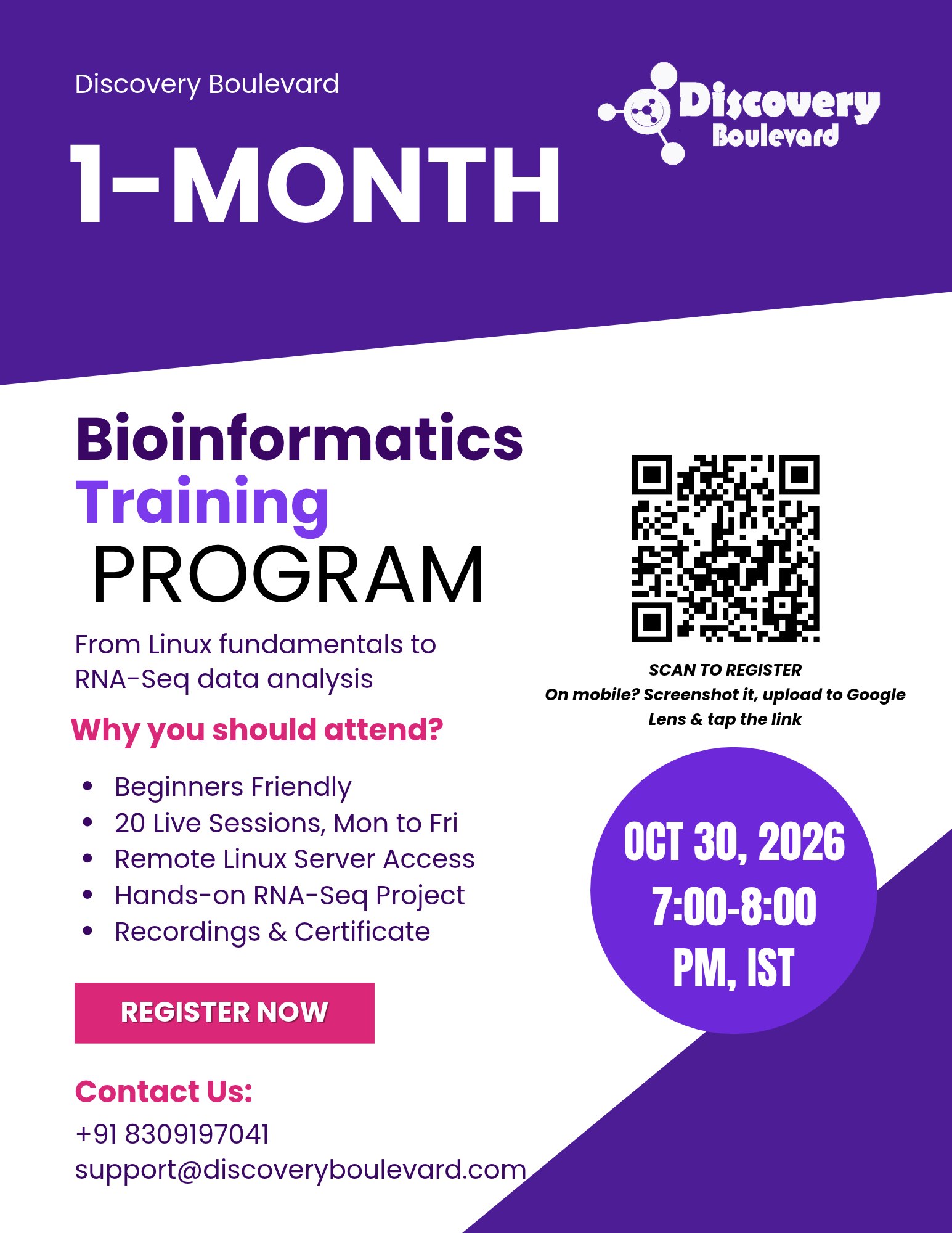
1-Month Bioinformatics Training
From Linux fundamentals on a remote server to a complete hands-on bulk RNA-Seq project.
What the training covered
A one-month program designed for complete beginners entering bioinformatics and transcriptomics. Every participant gets individual login credentials to a remote Linux server from the first session, and practises on real biological datasets, including publicly available large-scale sequencing data.
Over 20 live practical sessions you learn to run commands, process biological files, run bioinformatics tools and troubleshoot errors. You progress from Linux fundamentals to NCBI databases, BLAST, sequence alignment and primer design, and finish with a guided bulk RNA-Seq mini project on public sequencing data.
Sessions run live online from 7:00 to 8:00 PM IST, Monday to Friday, with live instructor guidance throughout and a dedicated WhatsApp group for queries, troubleshooting and technical help.
- Linux commands for real FASTA, FASTQ and tabular data
- NCBI, PubMed, BLAST and multiple sequence alignment
- PCR / qPCR primer design with Primer3 and Primer-BLAST
- A guided bulk RNA-Seq mini project on public data
- Linux (remote server)
- PuTTY / WinSCP
- NCBI
- BLAST
- Clustal Omega / MUSCLE
- Primer3
- Primer-BLAST
- FastQC
- fastp
- HISAT2
- SAMtools
- featureCounts
- DESeq2
Curriculum
Day by day
- Week 1 · 30 Oct – 5 Nov
Linux Essentials & Remote Server Access
- Day 1 · Fri 30 Oct: Introduction to bioinformatics and Linux; Ubuntu, WSL, PuTTY, WinSCP and FileZilla; Server login and training server setup
- Day 2 · Mon 2 Nov: pwd, ls, cd and cd ..; Absolute vs relative paths
- Day 3 · Tue 3 Nov: touch, mkdir, rmdir, rm, rm -r and cat
- Day 4 · Wed 4 Nov: cp, mv and renaming files; Wildcards (*)
- Day 5 · Thu 5 Nov: File permissions and hidden files; Metacharacters, pipes (|) and combining commands
- Week 2 · 6 – 12 Nov
Linux Commands for Real Bioinformatics Data
- Day 6 · Fri 6 Nov: head, tail and wc; Exploring large FASTA / FASTQ files
- Day 7 · Mon 9 Nov: cut, paste, sort and uniq; Processing tabular biological data
- Day 8 · Tue 10 Nov: grep and advanced searching; Regular expressions on biological datasets
- Day 9 · Wed 11 Nov: ps, kill and nohup; Background jobs and long-running tasks
- Day 10 · Thu 12 Nov: gzip and gunzip; Combining commands for efficient data processing
- Week 3 · 13 – 19 Nov
Biological Databases & Sequence Analysis
- Day 11 · Fri 13 Nov: Introduction to NCBI; Gene database searching and information retrieval
- Day 12 · Mon 16 Nov: NCBI Nucleotide and Protein databases; Sequence retrieval and FASTA files
- Day 13 · Tue 17 Nov: PubMed literature search; Exploring published biological research
- Day 14 · Wed 18 Nov: BLAST (blastn, blastp); Score, % identity, query coverage and E-value
- Day 15 · Thu 19 Nov: Pairwise vs multiple sequence alignment; Identifying conserved regions
- Week 4 · 20 – 26 Nov
Primer Design & RNA-Seq Mini Project
- Day 16 · Fri 20 Nov: Multiple alignment with Clustal Omega / MUSCLE; Consensus sequence identification
- Day 17 · Mon 23 Nov: Primer design principles; GC%, melting temperature (Tm), hairpins and dimers
- Day 18 · Tue 24 Nov: Primer design with Primer3; Specificity checks with NCBI Primer-BLAST
- Day 19 · Wed 25 Nov: The bulk RNA-Seq workflow; QC, trimming, alignment, read counting and differential expression
- Day 20 · Thu 26 Nov: Hands-on RNA-Seq mini project on public data; FastQC, fastp, HISAT2, SAMtools, featureCounts and DESeq2; PCA, heatmaps, volcano plots and biological interpretation
Recordings & materials
Get the recorded videos and materials
This training has already been conducted, so there is no registration form. If you would like the recorded sessions and the training materials, simply pay the fee using the links below. The fee and what is included are listed on the payment page.
₹8,500 / $120
Rupees for participants in India, US dollars for international participants.
What you receive
- Individual login credentials for a remote Linux server
- Hands-on exercises on real and public sequencing datasets
- Recorded videos of all sessions
- Course materials and step-by-step workflow tutorials (PDF)
- A dedicated WhatsApp group for queries and troubleshooting
- Live instructor guidance and doubt-clearing
- Certificate of participation