Previously conducted training
3-Day ADMET & ML Drug Discovery Training
Take one real EGFR project from molecular structure to a developability decision with ADMET profiling, machine learning and docking.
What the training covered
Most drug candidates that fail in development do not fail because they miss their target. They fail because the body never lets enough of the molecule reach that target safely. This three-day workshop teaches ADMET (absorption, distribution, metabolism, excretion and toxicity) as a practical, logical drug-discovery workflow rather than a list of numbers produced by a website.
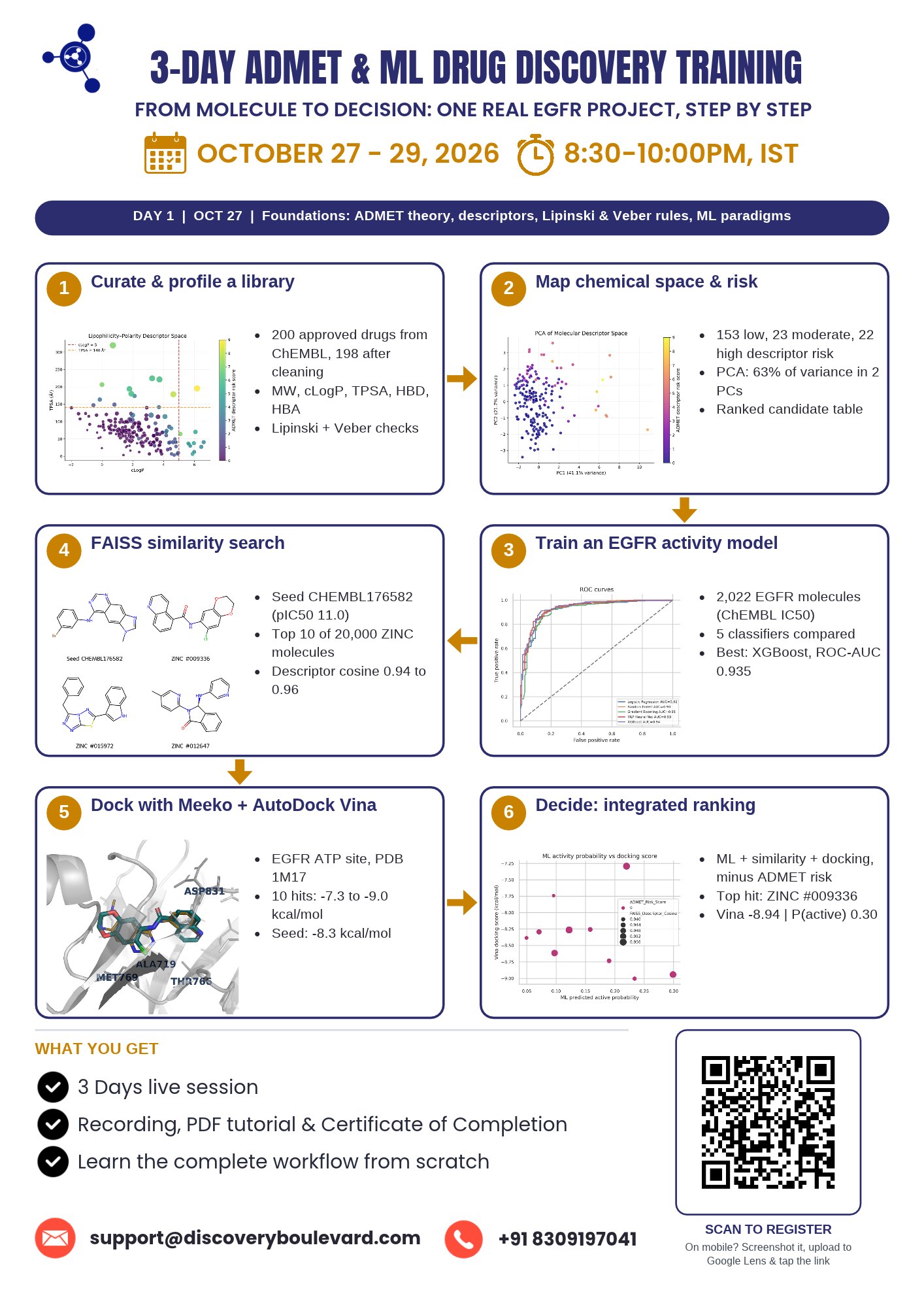
Day 1 builds the biological and computational foundation. Day 2 turns that foundation into an automated ADMET profiling pipeline for a compound library. Day 3 closes the loop with a small end-to-end discovery project: a target-specific machine-learning model, FAISS descriptor-space similarity search, ADMET filtering and docking-supported validation against EGFR kinase (PDB 1M17). Everything runs in Google Colab, and no prior programming experience is required.
- ADMET theory, descriptors, Lipinski & Veber rules and ML paradigms
- Automated ADMET profiling of a compound library with RDKit
- EGFR activity models from ChEMBL data, judged by ROC-AUC
- FAISS similarity search and docking with Meeko + AutoDock Vina
- Google Colab
- RDKit
- ChEMBL
- scikit-learn
- XGBoost
- FAISS
- Meeko
- AutoDock Vina
Curriculum
Day by day
- Day 1
ADMET Theory and Machine Learning-Based Prediction
- Why potent molecules fail: Fialuridine and Torcetrapib
- Solubility, Caco-2, PAMPA, P-gp efflux, plasma protein binding and BBB
- CYP metabolism, clearance, half-life, hERG, Ames and DILI
- MW, cLogP, TPSA, HBD, HBA and rotatable bonds
- Lipinski and Veber rules as warning lights
- Supervised, unsupervised and reinforcement learning paradigms
- Day 2
Automated ADMET Profiling
- 200 reference molecules from ChEMBL, or your own SMILES file
- SMILES validation, canonicalization, salt stripping and duplicate removal with RDKit
- 2D structure grids, MMFF-optimized 3D conformers and py3Dmol views
- Core descriptors and automated Lipinski and Veber evaluation
- cLogP versus TPSA maps, descriptor heatmaps and PCA of chemical space
- ADMET risk flags and a risk-ranked candidate table
- Day 3
ML-Guided Discovery and Molecular Docking
- EGFR IC50 data from ChEMBL converted to pIC50
- Classifiers including random forest and XGBoost, judged by ROC-AUC, F1, precision and recall
- FAISS search for the 10 molecules closest to a known active
- ML activity probability and ADMET risk for each hit
- Ligand preparation with Meeko and docking into EGFR (PDB 1M17) with AutoDock Vina
- Pose comparison and an integrated final ranking
Recordings & materials
Get the recorded videos and materials
This training has already been conducted, so there is no registration form. If you would like the recorded sessions and the training materials, simply pay the fee using the links below. The fee and what is included are listed on the payment page.
₹1,200 / $20
Rupees for participants in India, US dollars for international participants.
What you receive
- Recorded videos of all sessions
- Three ready-to-run Google Colab notebooks
- PDF tutorial covering the complete workflow
- Certificate of Completion