Previously conducted training
7-Day Hybrid Molecular Docking Series
What docking tutorials leave out: choosing a docking-ready structure, finding the biologically relevant pocket, and reading a score in context.
What the training covered
A seven-day hybrid series for beginners who want to learn molecular docking from scratch. Each day's session was released as a recording at 8:30 PM IST, so you can learn at your own pace with no live attendance required.
You learn to prepare proteins and ligands, set up and optimise docking, automate the whole workflow with Python, analyse the results and make publication-ready images. No licensed software is needed: tools, scripts and step-by-step tutorials are provided.
- Structure checks, AlphaFold, Modeller & SWISS-MODEL
- Pocket prediction with Fpocket and DoGSiteScorer
- Interaction analysis in Maestro and Discovery Studio
- Batch docking and result ranking with Python
- Re-docking validation (RMSD ≤ 2.0 Å) and publication-ready images
- AutoDock
- AutoDock Vina
- AutoDockTools
- PyRx
- Python
- Maestro
- SWISS-MODEL
- Modeller
- AlphaFold
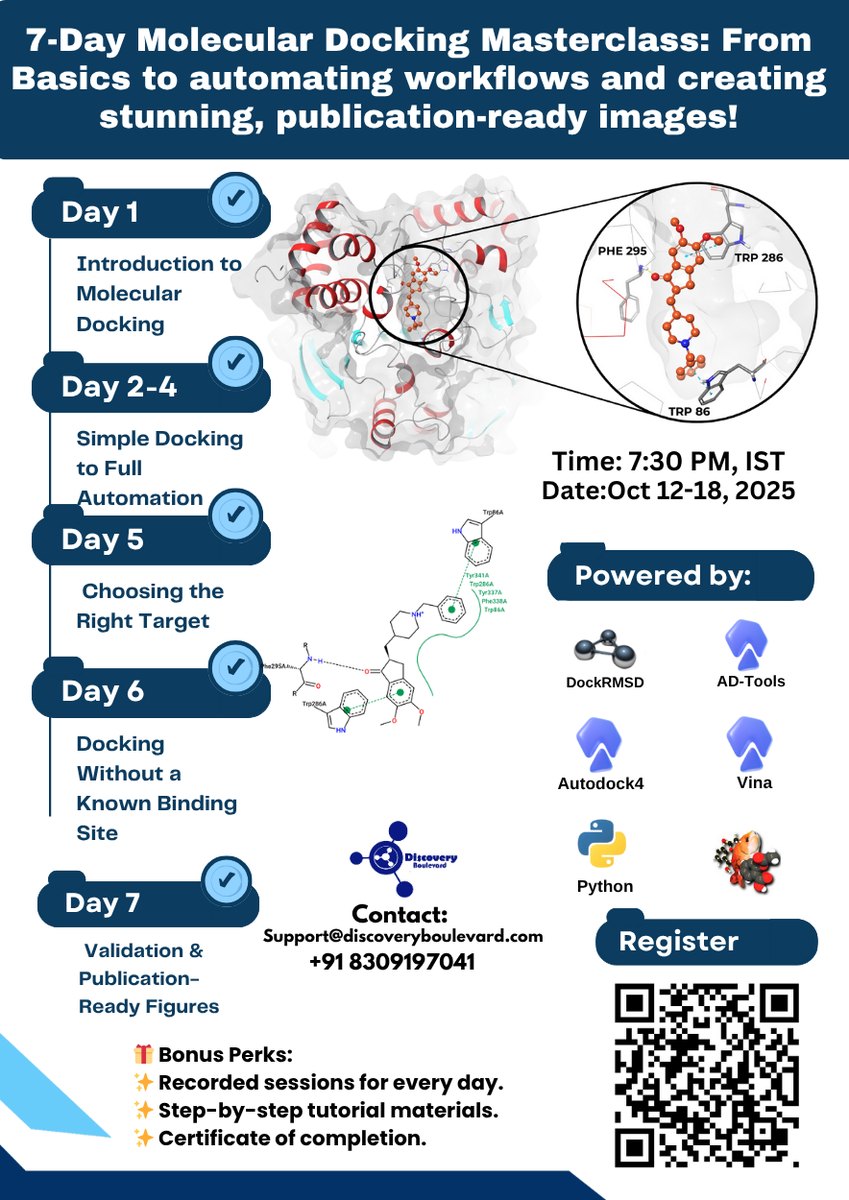
Curriculum
Day by day
- Day 1
Introduction to molecular docking
- What docking is and why it matters in drug discovery
- Key concepts: receptor, ligand, binding affinity and binding site
- Docking software (AutoDock, Vina) and auxiliary tools (AutoDockTools, Maestro)
- Days 2–4
From simple docking to complete automation
- AutoDock overview, installation and setup
- Preparing the receptor: cleaning the PDB structure, adding hydrogens and charges
- Preparing the ligand: hydrogens, charges and rotatable bonds
- Grid box and docking parameters; running AutoDock
- Interpreting poses and scores; visualising interactions in Maestro
- Multi-ligand docking with AutoDock Vina and PyRx
- Python automation: SDF to PDBQT conversion, energy minimisation and batch docking
- Extracting affinities from log files, ranking hits and exporting top poses to SDF
- A reusable template script that scales from small libraries to thousands of molecules
- Day 5
Choosing the right PDB or target structure
- Criteria for high-quality crystal structures: resolution and completeness
- Missing residues or unsolved structures: SWISS-MODEL, Modeller and AlphaFold
- Refining and validating models
- Day 6
Docking without a known binding site
- Binding-site prediction tools, with a practical demonstration
- Databases and resources for binding-site information
- Day 7
Validation and image generation
- Re-docking to validate the protocol
- Publication-ready 3D protein–ligand interaction images
- Q&A and troubleshooting of common issues
Recordings & materials
Get the recorded videos and materials
This training has already been conducted, so there is no registration form. If you would like the recorded sessions and the training materials, simply pay the fee using the links below. The fee and what is included are listed on the payment page.
₹1,800 / $30
Rupees for participants in India, US dollars for international participants.
What you receive
- Recorded sessions for all seven days
- Tools, scripts and step-by-step tutorial materials
- Recorded video answers to your questions
- Ongoing support for questions after the workshop
- Certificate of completion